
Locked Out! "For your Safety"- How Australia Decided We Need Permission to Read!
They Came for Our Substack. Who's Next?

We were shut out of our own account over the holiday period — without warning, without communication, and without having done anything wrong. We weren’t alone. Here’s what happened, why it matters, and what we want to know from you…
The Wall We Hit Over Christmas
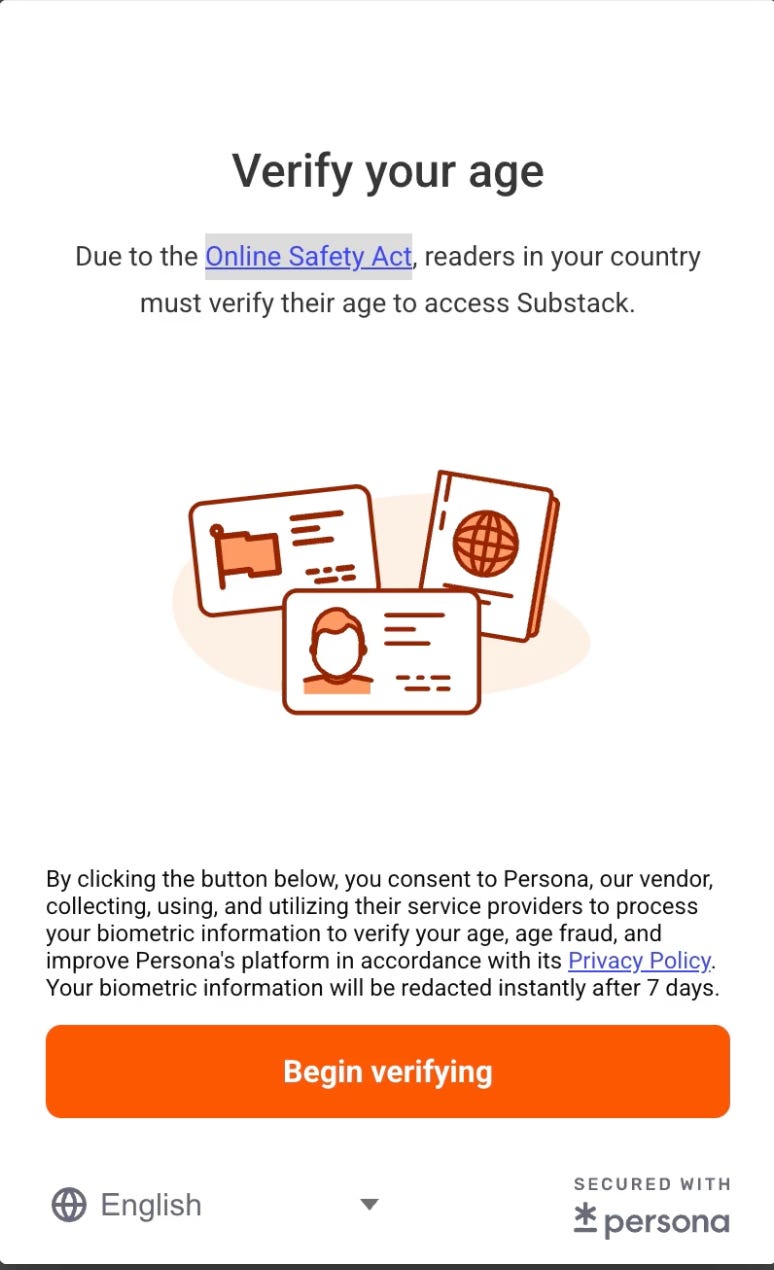
Just before the new year, we tried to log into our WCH Australia Substack account as usual. Instead of seeing our Substack sign-in page we were met with a pop-up blocking us from going any further until we had “verified our age”. No warning. No prior email from Substack. No explanation. Just a prompt from a third-party biometric ID provider called Persona, asking us to submit government identification or undergo facial recognition — and a single orange button: Begin Verifying.
It was, to put it plainly, a shock, frustrating and disappointing. This platform is our primary channel of communication with you — our readers. Being cut off from it without notice, and with no clear path to resolution that didn’t involve handing over our biometric data to a private company, was not a small thing.
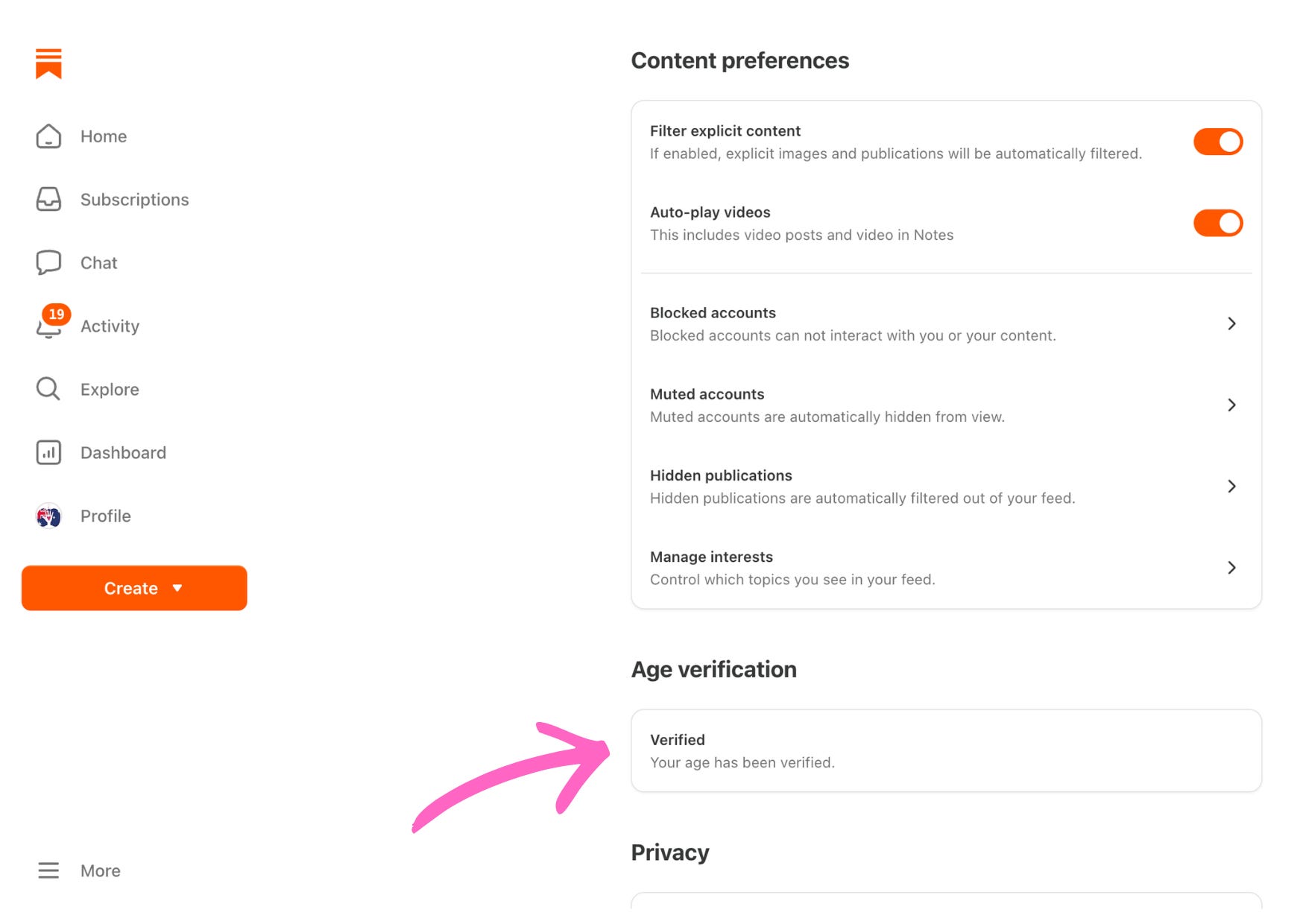
We were locked out for several weeks. And then, just as mysteriously as it had appeared, the wall was gone. We regained access to our account — without ever completing the age verification process. We still don’t know exactly why, or how.
What we do know is this: we were not the only ones.
What Actually Happened — And Who Is Behind It
In November 2024, the Australian Government passed the Online Safety Amendment (Social Media Minimum Age) Act 2024. The pretext: prevent Australians under 16 from having accounts on social media platforms. The law came into effect on 10 December 2025, carrying penalties of up to AU$49.5 million for platforms that failed to take “reasonable steps” to verify user ages.
The platforms officially named as age-restricted were: Facebook, Instagram, TikTok, Snapchat, X (Twitter), Reddit, Threads, Twitch, Kick, and YouTube. Substack was not on that list. Neither, for what it’s worth, were messaging platforms like WhatsApp, Discord, and Messenger, or gaming platforms like Roblox and Steam — these categories were explicitly excluded by ministerial rules, justified on the basis that their primary purpose is not social interaction. Pinterest was also cleared. Substack, a platform whose entire purpose is publishing and reading, was not.
Here is the part that should give every Australian pause: under this law, platforms are NOT required to be specifically named to be obligated to comply. Only platforms expressly excluded are exempt. Everything else is presumed to be covered.
This inverts the traditional legal principle that everything is permitted unless expressly prohibited. It represents a sweeping re-architecture of how online speech is regulated — and Substack, a platform built on long-form writing, journalism, and political commentary, found itself caught in this grey area.
Substack’s own position on this is worth noting. In an October 2025 statement, the company said that while it respected Australia’s right to make its own laws, mandatory age verification carries “real costs to free expression” and introduces friction that “forces an identification step before people can read on the internet.” Despite these objections, Substack chose to comply — and began imposing age checks on Australian users from December 10, 2025. For a company built on championing independent voices, it was a notable capitulation.
Substack Built Its Brand on Free Expression — Then Handed Its Users to the State
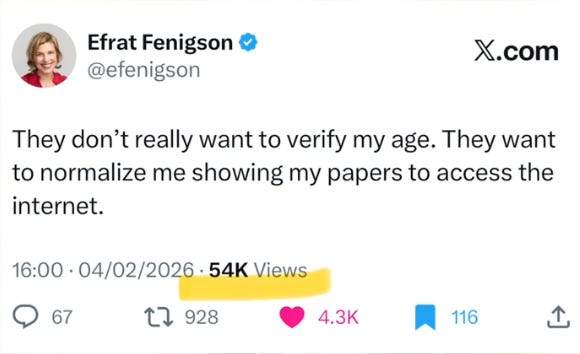
Efrat Fenigson found this out the hard way — and her story has a twist that makes it even harder to dismiss. An international journalist and podcast host with over 4,700 Substack subscribers, Fenigson was visiting Australia in early February 2026 when Substack locked her out of her own account. She refused to submit to biometric age verification — and yet the lockout persisted even after she left Australia and travelled to Indonesia. Let that sink in: the law applies only to those “ordinarily resident” in Australia but when she was no longer in Australia, Substack still kept her out.
In a post that garnered over 167,000 views on X, she said, “The world is watching, as we encounter the forks of control vs. freedom.” Read her full account here: “Substack Locked Me Out, For My Safety Of Course”
📹 Watch: Efrat Fenigson talk about her experience of being locked out of her Substack account - even after leaving Australia.
After three weeks of being locked out, Fenigson was restored to her account — again, without completing verification. She credits social media pressure and behind-the-scenes contact with US government officials. Her story was subsequently picked up by Sky News Australia’s Outsiders program.
Dr. Phillip Altman: A Writer Separated From His Audience
Dr. Phillip Altman, a pharmacologist and clinical trials expert who has published over 450 Substacks over three years on topics including COVID-19 policy and vaccine safety, posted a stark message to his readers on 4 January 2026: “Moving to X.”
“Substack has willingly acquiesced to institute biometric ID on my posts,” he wrote. “I know this is most disappointing to my subscribers, in particular, because they fully understand the slippery slope of government censorship facilitated by digital ID in the name of ‘keeping you safe’. It is an old trick.”
Many of Dr. Altman’s readers had already told him they could not access his work without providing biometric data — and had refused. He was essentially separated from his audience not by his own choice, but by a platform decision that his readers would not accept. He announced he would begin posting directly to X instead, while keeping his Substack running for those who could still access it.
This is not a fringe outcome. This is the point.
The Bigger Picture: Is This Really About Child Safety?
We want to be clear: none of us object to protecting children online. What we do object to is the Trojan horse this legislation represents — and the nanny state appointing itself co-parent without being asked.
As Efrat Fenigson put it in her video: ‘The state is our babysitter, right? The state is our parent — it needs to tell us if we are allowed or not to go to a specific website. It’s not the parents’ job anymore. It’s the state’s job now to tell us what we can or cannot do online.’
Parents didn’t ask for this. Most don’t want it. Because parents who are paying attention understand that this was never about their children — it was about building the infrastructure of control.
There is also a legal fight underway in relation to these laws. The Digital Freedom Project, led by NSW Libertarian MP John Ruddick, has launched a High Court challenge to the law, arguing it violates the implied constitutional freedom of political communication. The High Court agreed to hear the case in December 2025, with arguments scheduled for 2026.
This fight is not over. But we should also ask ourselves honestly: can we trust that the judicial system will protect free expression when governments and regulators are this determined to restrict it?
The pattern is replicating elsewhere. Governments across the world — in Australia, the UK, the EU and now also Malaysia, France, Denmark, Greece, Spain, Brazil, and Ireland — are using child safety as the justification for building verification infrastructure that, once in place, can be applied to far more than keeping teenagers off social media.
As Fenigson put it when she appeared on Spectator TV Australia: “Why is the ‘laid back colony’ of Australia leading the world in the UN digital censorship revolution? Governments across the West have been the largest source of misinformation and disinformation. So, is this about child protection — or is it about politics?”
It is a question we believe every one of our readers should be asking.
If You’ve Been Locked Out: A Practical Resource
Australian writer Grace Mary Power documented her own lockout in forensic detail — including the contact forms, department emails, and escalation steps that actually worked. If you need to recover your account, turn off paid subscriptions, or remove payment details without completing age verification, her guide is the most thorough resource we’ve found: Substack Age Verification in Australia — by Grace Mary Power. Note: a free Medium account may be required. The contact that worked best: tos@substackinc.com
Take Action: Contact Substack Directly
Substack responds when enough people push back — accounts were reinstated without age verification, including ours. If you’ve been affected, or simply object to this overreach on principle, lodge a formal complaint with Substack’s Standards & Enforcement team. Put your concerns on the record. The pressure worked before. It can work again.
A Note on Platform Dependency — And What We’re Doing About It
This experience has reinforced something we have been thinking about for some time: we are too dependent on a single external platform as our primary communication channel. Substack is a wonderful tool, but as this experience demonstrates, access to it can be disrupted — by law, by platform decisions, or by both — at any time and without warning.
We are therefore taking steps to ensure that our relationship with you is not contingent on Substack’s continued accessibility. We will be rebuilding our email newsletter as a direct, independent communication channel — so that regardless of what any platform decides, we can still reach you, and you can still reach us.
We will share more details on this shortly. In the meantime, we’d encourage every reader to ensure we have your current email address.
We Want to Hear From You
This is not just our story — and we suspect it is not just the story of the people mentioned in this article. We are asking our community directly:
1. Have you been hit with an age verification wall on Substack? How did you respond?
2. Did you complete the verification — and if not, were you eventually able to regain access anyway? Or have you left the platform entirely?
Please leave your responses in the comments below. And if you know someone who was affected by this — a reader, a writer, a fellow subscriber — please share this article with them. Some of the people most affected may no longer be on the platform at all, which is precisely why we’re also sending this via direct email.
We are stronger as a community when we know what is happening to each other.
— WCH Australia
Published 25 February 2026